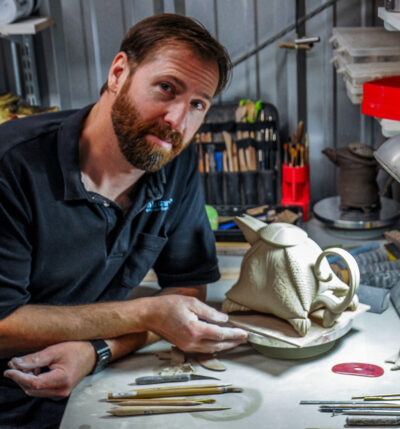
Workshop en ElTorn con el artista Robert Lawarre III
Interview with Robert Lawarre III, When Mechanics Meets Clay
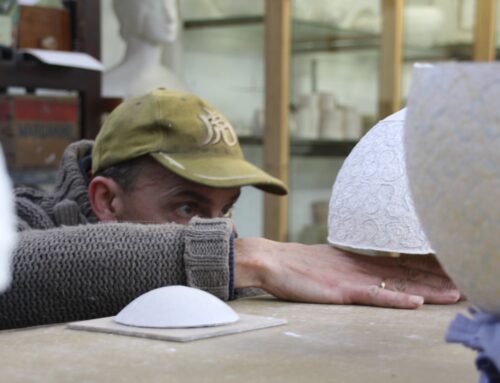
Before dedicating himself fully to ceramics, Robert Lawarre worked in the world of mechanics and auto racing. That experience still shapes his artistic language today. Many of the textures that appear in his work come from tools he builds himself using recycled automotive parts. His pieces often combine functional forms—teapots, cups and vessels—with surfaces that evoke rivets, industrial seams or casting marks. The result is a distinctive visual language where technique, play and experimentation coexist. We spoke with him about his process, his teaching philosophy and the role curiosity plays in his work.
Before dedicating yourself to ceramics you worked in the world of mechanics. How did that experience influence your work as a ceramic artist?
I grew up surrounded by machinery. When I was fourteen I was already working as a machining apprentice in my family’s aerospace business, and later I worked with a racing team. That experience gave me a very direct relationship with materials and tools.
Over time I started making my own tools for working ceramic surfaces using recycled automotive parts—things like belts, headlight lenses or mechanical components. Many of the textures that appear in my pieces come from those tools.
Your work often includes industrial references—rivets, seams, casting marks…
Yes, that language comes quite naturally to me. My visual vocabulary is strongly influenced by the world of manufacturing. In my pieces you can see references to rivets, screws, upholstery seams or casting marks. These are elements we normally associate with industrial objects, but I find it interesting to bring them into the ceramic context.
You began working with clay in the early 1990s. What drew you to the material?
I started working with clay in 1990, but it wasn’t until a few years later, while studying at Valencia Community College, that I realized this was the material I wanted to dedicate myself to. Later I continued my studies at the University of Central Florida, where I received my BFA in ceramics.
Ceramics has something very special. It combines material, technique and time in a very intense way.
You have also spent many years teaching. What role does teaching play in your artistic practice?
Teaching has been fundamental for me. For many years I worked as a teaching artist in art camps and public schools. Interestingly, that experience working with young students was one of the best educations I ever had.
Children approach materials with a lot of freedom and very little fear of making mistakes. That attitude has influenced my own way of working quite a lot.
You often talk about “serious fun.” What does that idea mean to you?
It’s a way of summarizing my philosophy about making. Ceramics requires discipline and dedication, but there should also be room for play, curiosity and experimentation.
Many of my surface techniques actually came from what initially looked like mistakes or accidents in the process. Sometimes the most interesting things happen when something doesn’t go as expected.
Many of your pieces are functional—teapots, cups and vessels.
Yes. I’m interested in working at that boundary between sculpture and functional objects.
Teapots, for example, have a very rich history in ceramics. I’ve always been fascinated by the Yixing teapots from China, where form, material and gesture are beautifully balanced. Objects like that invite interaction—they want to be handled, touched and used.
You will soon be teaching a workshop at EL TORN. What can participants expect?
In my workshops I like to share different techniques for working with form and surface. We talk about tools, construction methods and texture, but also about the creative process.
My goal is that participants leave with new ideas and with the desire to keep exploring.
Robert Lawarre’s work shows how ceramics can engage in dialogue with other worlds: mechanics, industry, manual gesture and playful experimentation with material. His pieces bring together technical precision and exploration, reminding us that the ceramic process is also a space for curiosity and discovery. I share with you his Instagram.
This May we will have the opportunity to work with him at EL TORN, in a workshop where he will share some of his techniques and his approach to form and surface.