Between Form and Illusion: A Conversation with Velimir Vukičević
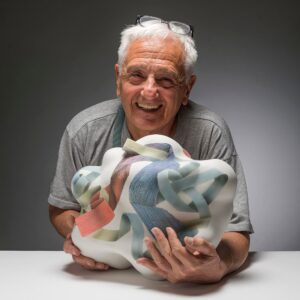
For more than five decades, Serbian ceramic artist Velimir Vukičević has explored the meeting point between sculpture and painting. Working primarily with porcelain, he uses colour, drawing and three-dimensional illusion to challenge our perception of ceramic form.
Ahead of his workshop at ElTornBarcelona, we invited him to speak about the origins of his artistic language, his creative process and the techniques behind his distinctive surfaces.
Do you remember what first attracted you to ceramics?
I began studying ceramics at the Academy of Applied Arts in Belgrade. At that time, gaining a place was very competitive: the ceramics department accepted only five students from approximately fifty candidates.
As a student, I found it difficult to choose between modelling and painting because I was equally interested in both. With the support of my professors, I realised that ceramics could allow me to bring these two interests together. That combination eventually became fundamental to my work.
Your work has a very distinctive visual language. How did it begin to develop?
It developed gradually. When I moved to Switzerland, the traditional Serbian designs I had previously made did not generate much interest. This forced me to question my work and search for a different direction.
It was an important turning point, although artistic change never happens immediately. Through continuous work and experimentation, I began to explore a stronger relationship between form, colour and visual illusion.
Where does your inspiration usually come from?
Inspiration comes from both outside and inside: from what we observe in the world and from what we carry within ourselves.
I am particularly interested in things that are constantly changing and are difficult to contain—clouds, water, wind and air. How can we give a physical form to something that never remains still? How can we suggest that air will continue to flow or that water will continue to move after the object itself has become static?
Clouds are especially inspiring to me. Their shifting forms speak about transience, movement and impermanence. They are like floating dreams that invite our imagination to create new images.
How does a new piece normally begin?
My process begins with an idea, but also with a great deal of planning. I make many sketches because my work requires both construction knowledge and a clear understanding of how the surface will interact with the form.
Sometimes I begin by searching for a form on which I can paint three-dimensional elements. In other works, I explore the contrast between solid and fragile forms.
I may also use a plaster mould to produce several versions of the same basic shape. I can then cut, add or alter elements and decorate each piece differently. The repeated form becomes a starting point, rather than a final result.
What role does porcelain play in your work?
I work almost exclusively with porcelain. I use different forming methods, including slip casting, slab building and wheel throwing, although in recent years slip casting has become particularly important in my practice.
Porcelain gives me a precise, luminous surface on which drawing and colour can become very present. I often use coloured slips made with pigments rather than relying heavily on traditional glaze. The material allows me to combine physical form and painted illusion in a very direct way.
How do you create the illusion of depth and volume on an already three-dimensional object?
I use drawing, painting, shadows and changes in colour to introduce forms that do not physically exist. These painted elements interact with the real shape of the object, sometimes following it and sometimes contradicting it.
I work with coloured slips, underglazes, overglazes, transfers, glazes, lustres and airbrush techniques. Paper masks and protected areas allow me to control the airbrush and create shadows or gradual changes in colour.
By painting an apparently three-dimensional form on an existing three-dimensional object, I can question what the viewer is seeing. Is it a real volume or simply a carefully constructed illusion?
Your work is technically precise, but it also feels playful. Is that contrast important to you?
Yes. My approach is quite rational because the pieces require planning, technical knowledge and control. But my ideas are often romantic, joyful and positive.
I am interested in playing with perception and creating visual puzzles. Technical precision is important, but it is not the final purpose. It is a tool that allows the piece to communicate and awaken curiosity.
After so many years of practice, what continues to motivate you?
I believe that individuality is one of the most important qualities in art. Artists need to look deeply into themselves and work persistently to discover what is truly their own.
Talent needs to be exercised. I continue working and experimenting because a personal language does not remain fixed; it must keep developing.
The process of transforming an idea into a physical object can be solitary, but once the work is shown, it creates communication. The object begins a dialogue with other people, and that exchange of energy is an important part of why I continue creating.
What would you like participants to discover during your workshop at ElTornBarcelona?
I would like them to understand that decorating a ceramic surface is not simply a final step or an additional ornament. Surface and form can be developed together, and decoration can completely transform how an object is perceived.
We will work with both technical and artistic questions: how to prepare and protect the surface, how to use different decorative materials and firing temperatures, and how to create depth, shadows and three-dimensional illusions.
Most importantly, I hope participants will use these techniques as a starting point for developing their own ideas and their own visual language.
Thank you, Velimir, for presenting and sharing so generously with us your art!
thank you!
If you would like to learn directly from the artist, Velimir will be holding a workshop here at ElTorn next February 15th to 19th 2027.
Whant to learn more? leave us your email here.
Warmly,
Paula