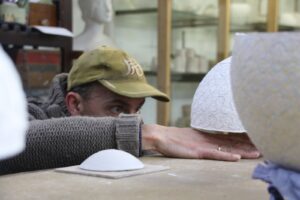
Belgium Artist Guy Leemput
Fragility as Form — The World of Guy Van Leemput
In the delicate balance between control and chance, Guy Van Leemput’s work pushes the limits of porcelain.
His pieces, so thin they seem almost impossible, are the result of a slow, precise, and deeply intuitive process, where material, time, and fire become collaborators.
In this conversation, the Belgian ceramic artist invites us into his creative universe: a space where fragility is not a weakness, but a way to explore how far both the material — and oneself — can go.
Guy, your work is very distinctive — those extremely thin, almost impossible pieces. How did it all begin?
Interestingly, it started with mathematics. I was a teacher for many years, but ceramics was always present in my life. At a certain point, I decided to follow that intuition more deeply. Ceramics was not a rational decision… it felt more like a calling.
What relationship do you see between mathematics and your ceramics?
More than people might expect. Mathematics taught me to observe patterns and efficient structures — how to create something strong using the least amount of material. In my work, that logic combines with something much more intuitive. I often say: the heart defines the shape, the mind makes the decisions.
Your technique is quite unique. Can you explain it?
I work with extremely thin porcelain, often built on a balloon. It’s a very slow process: each day you can only add a small amount of material, and a single piece can take weeks. Then comes the key moment — the kiln. Pieces are sometimes fired upside down, allowing gravity and heat to play an active role in the final result.
It sounds like you don’t control everything…
Exactly. And that’s what makes it interesting. There’s a balance between control and letting go. Fire, gravity, time… they are all collaborators. It’s not just about technique, it’s about accepting that not everything depends on you.
What are you trying to convey through your pieces?
When I open the kiln and a piece has survived… there is a very emotional moment. Almost silent. My goal is for the viewer to feel something similar. It’s not just an object — it’s a condensed experience.
You’ve worked in China and exhibited internationally… what have you learned from that journey?
That ceramics is a universal language, but each culture has its own rhythm. In Jingdezhen, for example, you really feel the weight of tradition. It makes you more humble… and at the same time, more free.
You often talk about time and slow process. Why is that so important?
Because we live in a culture of immediacy. Ceramics forces you to slow down. For me, working with clay is like yoga for the mind. It’s a way to be present, to breathe with the material.
What can someone expect if they attend one of your workshops?
Not just learning a technique. They will learn to observe, to be patient, to accept mistakes as part of the process. And above all, to trust something that cannot be fully controlled.
What makes your approach unique compared to other ceramic artists?
I think it’s that combination: mathematical precision and vulnerability in the process. I am always searching for the limit — working with the least amount of material possible without collapse. That’s where the magic happens.
Beyond technique, Guy Van Leemput’s work reminds us that ceramics — like any creative process — is an exercise in balancing intention and surrender. In a world that rewards immediacy, his practice offers the opposite: to slow down, to observe, and to trust what cannot be fully controlled. Perhaps this is where the true strength of his pieces lies — and also the invitation he extends to those who encounter his work.
An invitation we will soon have the opportunity to explore up close at ElTorn, where Guy will share his process in a comprehensive workshop. Click here and leave us your email if you’d like to be notified in advance about the program and dates.
Warmly,
Paula