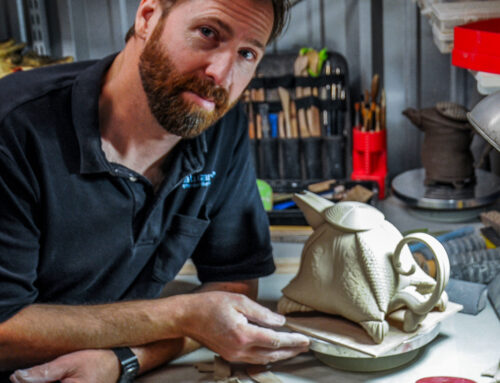
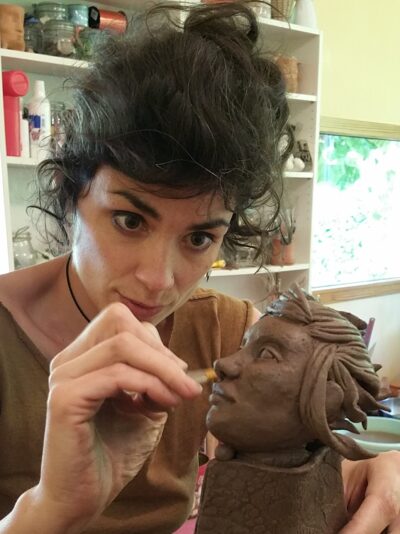
C.A. Traen ceramicist artist
Interview with the ceramicist artist C.A. Traen: The Body as a Space of Tension and Transformation
Before building an international career as both artist and educator, C.A. “Cat” Traen developed a practice rooted in the human figure—using clay to explore identity, pressure and the complexity of contemporary life.
Working primarily through figurative sculpture, her pieces often present bodies that stretch, fragment or multiply, reflecting the tension between personal experience and external expectations.
Alongside her studio work, teaching and community-building have become central to her practice, shaping the way she approaches both making and sharing knowledge.
We spoke with her about the body, process and the role of ceramics as a space for reflection.
Your work often revolves around the human figure. What draws you to the body as a subject?
The human figure is something we all immediately connect to. It’s familiar, but at the same time it allows for a lot of complexity.
For me, the body becomes a way to talk about both personal experience and broader social dynamics—how we exist within systems, expectations and pressures.
In your work, the body often appears stretched, fragmented or multiplied. What are you exploring through these forms?
Those forms come from a feeling that many of us share—being pulled in multiple directions at once.
We are constantly navigating responsibilities, expectations and the pace of contemporary life. The fragmented or multiplied body reflects that tension, that sense of being divided or extended beyond ourselves.
There’s a strong emotional dimension in your pieces, even when they remain quite minimal.
Yes, I’m interested in that balance.
I don’t necessarily want to overwork the surface or make things overly complex. Sometimes a simplified form can carry more emotional weight.
It allows space for the viewer to project their own experience into the piece.
How do you approach the process of building a figure?
I tend to work in a very direct way.
Structure is important—understanding how the figure stands, how weight is distributed—but I also try to leave space for intuition and gesture.
There’s always a moment where the piece starts to move away from the initial idea, and that’s usually where it becomes more interesting.
Teaching has been a big part of your career. How does it influence your work as an artist?
Teaching and making are very connected for me.
Working with so many students over the years has shown me how different people approach the same problem in completely different ways. That diversity of thinking feeds back into my own practice.
It also reinforces the idea that there isn’t a single “correct” way to make something.
Community seems to play an important role in your work.
Yes, absolutely.
For me, ceramics is not just about the object—it’s about the people around it. The conversations, the shared process, the exchange of knowledge.
Creating spaces where people feel comfortable experimenting and learning together is something I care deeply about.
What role does curiosity play in your practice?
It’s essential.
Curiosity is what keeps the work evolving. It allows you to question your own habits, to try new approaches, to stay open.
Without that, the work can become repetitive very quickly.
C.A. Traen’s work reminds us that figurative sculpture is not only about representation, but about experience—how we inhabit our bodies, how we navigate the world, and how those tensions can be translated into form.
Through clay, she builds figures that feel both personal and collective, grounded in structure yet open to interpretation.
This May, she will bring this approach to EL TORN in a workshop focused on figurative sculpture.
Check here the full program :-). See you in May!